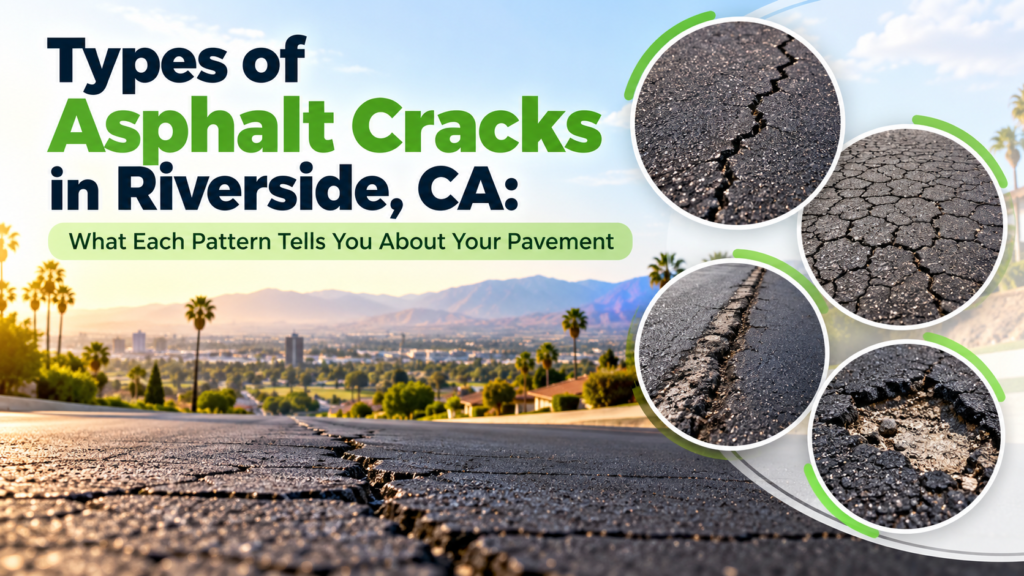
Asphalt pavement cracks. This is not a sign of failure in the abstract it is the expected outcome of a material that expands and contracts with temperature, flexes under load, and is exposed to a climate that in Riverside can push surface temperatures above 150 degrees Fahrenheit in summer and drop to near freezing on winter nights. The question is not whether Asphalt Cracks Riverside, but what specific pattern the cracking takes, what that pattern reveals about the underlying cause, and what response is appropriate for each situation.
Riverside sits in the Inland Empire of Southern California, where the combination of intense UV radiation, extreme diurnal temperature swings, Santa Ana wind events, and occasional winter frost creates a pavement environment that generates a wider range of crack types than more moderate climates. Recognizing each type of crack and understanding its cause is the first step in any meaningful pavement maintenance program.
Longitudinal Cracking: Cracks Running Parallel to the Road or Driveway Direction
Longitudinal cracks run parallel to the direction of travel or along the length of a driveway. They are among the most common cracks observed on Riverside pavement and can have several distinct causes depending on their location within the pavement cross-section.
Longitudinal cracks near the center of a roadway or parking lane often result from traffic-induced fatigue. Repeated wheel loadings in the same track common on rural roads where vehicle paths are consistent cause the pavement to flex beyond its fatigue limit, initiating cracks at the bottom of the asphalt layer that propagate upward. These are early-stage fatigue cracks and should be addressed before they develop into the interconnected alligator pattern.
Longitudinal cracks near the edge of the pavement are more often caused by inadequate edge support. In Riverside, where many residential driveways and rural roads lack proper curbing or compacted aggregate shoulder support, the pavement edge loses lateral confinement over time. The edge section flexes more than the supported interior, and longitudinal edge cracking develops. These cracks allow water infiltration directly into the subbase at the pavement’s weakest point.
Shrinkage is another cause of longitudinal cracking in Riverside’s climate. Asphalt binder hardens and becomes brittle as it oxidizes under UV exposure, and as the binder contracts in cool weather, the stiffer material cracks. Longitudinal shrinkage cracks are typically straight, clean-edged, and spaced at intervals corresponding to the thermal stress distribution in the pavement. They appear first in the oldest parts of the pavement and in areas with the most UV exposure.
Transverse Cracking: Cracks Running Perpendicular to the Pavement Direction
Transverse cracks cross the pavement perpendicular to the direction of travel. In Riverside, these are primarily thermal cracks caused by the extreme temperature differential between summer and winter, and between day and night temperatures in all seasons.
When asphalt cools, it contracts. When the thermal contraction stress exceeds the tensile strength of the binder which becomes brittle as it oxidizes and ages the pavement cracks transversely. The spacing of transverse cracks is related to the stiffness of the binder and the pavement thickness: stiffer, thinner pavement develops more closely spaced transverse cracks. Riverside’s diurnal temperature swings of 30 to 40 degrees in spring and fall are particularly effective at generating transverse cracking in aged pavements.
Transverse cracks that are left unsealed allow water to enter the pavement structure. In Riverside, even rainfall during the winter wet season, combined with the thermal cycling between cool nights and warm days, can drive enough moisture infiltration through transverse cracks to saturate the subbase and accelerate pavement deterioration.
Alligator Cracking: Interconnected Crack Networks Indicating Structural Failure
Alligator cracking named for its resemblance to an alligator’s hide is the pattern of interconnected crack polygons that indicates the asphalt layer has failed structurally. It is the most serious crack type in terms of its implications for the pavement’s remaining service life and for the appropriate repair strategy.
Alligator cracking in Riverside results from repeated load-induced flexing of the pavement beyond its fatigue strength. The initial cracks form at the bottom of the asphalt layer and propagate upward under continued loading. Once the crack network reaches the surface and the individual polygons begin to rock under traffic, the pavement is actively breaking apart. Surface treatments sealcoating, crack filling cannot address alligator cracking because the structural problem is in the base and subgrade, not the surface.
In Riverside’s clay-bearing soils, alligator cracking often correlates with locations where subgrade moisture fluctuates: areas that collect drainage, sections where irrigation overspray from adjacent landscaping saturates the subgrade, or locations where buried utility trenches were not backfilled to the proper density. The weak zone migrates upward through the pavement structure over time, and the surface expression is the alligator pattern.
Edge Cracking: Deterioration at the Pavement Boundary
Edge cracking develops at the outer boundary of paved surfaces, typically within one to two feet of the edge. In Riverside, this is a common failure mode in driveways and parking lot sections that were constructed without proper edge restraint or where the adjacent shoulder material has eroded or been undermined by irrigation water.
The mechanism is simple: without lateral confinement, the asphalt edge deflects more under load than the supported interior. The repeated differential deflection causes the edge to fatigue and crack. Once cracking begins, vegetation root intrusion a significant factor in Riverside’s warm climate where plants grow aggressively along pavement edges accelerates the process by growing into cracks and widening them.
Preventing edge cracking requires proper edge support from the outset concrete curbing, compacted aggregate shoulders, or metal edge restraints. Repairing edge cracking that has progressed involves cutting back the damaged edge, recompacting the subbase, and replacing with new asphalt to a consistent depth and width.
Block Cracking: Large Regular Polygons Indicating Binder Hardening
Block cracking produces a pattern of large rectangular or square crack polygons, typically 1 to 10 feet in dimension, covering substantial areas of pavement surface. Unlike alligator cracking, block cracking is not primarily a traffic-load phenomenon it occurs on both trafficked and non-trafficked areas and reflects the hardening of the asphalt binder as it ages.
In Riverside, block cracking is accelerated by the region’s intense UV radiation and high pavement surface temperatures. The binder oxidizes rapidly in the Inland Empire’s climate, becoming harder and more brittle over time. As the stiffened binder contracts with temperature drops, its reduced flexibility means it cracks rather than accommodating the thermal movement. Block cracking is particularly common on driveways and parking lots that have not been sealcoated, because the sealcoat provides UV protection that significantly slows binder oxidation.
Slippage Cracking: Crescent-Shaped Cracks from Surface Shear
Slippage cracks are crescent or half-moon shaped crack patterns that develop when the surface course of asphalt slides relative to the layer beneath it. This happens when the bond between surface course and underlying layer is weak typically from a bond coat that was not applied properly or from contamination of the surface between lifts during construction.
In Riverside, slippage cracking is most often observed at bus stops, intersections, and commercial driveway aprons where braking and turning loads apply high shear stress to the pavement surface. The hot summer conditions that soften the binder contribute by reducing the shear resistance of the surface course. Repair requires removing the delaminated surface course, preparing the underlying layer with a tack coat, and replacing with properly bonded new asphalt.
Reflection Cracking: Cracks Mirroring Underlying Joints
Reflection cracking occurs in asphalt overlays placed over cracked or jointed concrete or over an existing cracked asphalt surface. The cracks in the underlying layer propagate upward through the overlay in response to thermal movement and traffic loading, reflecting the pattern of the original cracks.
This is a common issue in Riverside where asphalt overlays have been placed over older concrete driveways or over previously cracked asphalt lots. The overlay may look smooth when first placed, but within one to three winters the cracks below reappear at the surface. Addressing reflection cracking requires either full-depth reconstruction or the use of interlayer systems geotextile fabrics, stress-absorbing membrane interlayers that are designed to interrupt the crack propagation path.
Frequently Asked Questions: Asphalt Cracks in Riverside, CA
What type of crack is most serious in Riverside pavement?
Alligator cracking indicates structural failure in the base or subgrade and cannot be repaired with surface treatments. Full-depth repair is required. Edge cracking and longitudinal cracking are serious if left unaddressed because they allow water infiltration that accelerates base deterioration.
Why does asphalt crack more in Riverside than in cooler climates?
Riverside’s intense UV radiation accelerates binder oxidation, hardening the asphalt and making it more brittle. The extreme diurnal temperature swings hot afternoons, cool nights drive thermal contraction cracking. The combination of UV aging and temperature cycling produces cracks faster than in more moderate climates.
Can block cracking be sealed?
Block cracking that has not progressed to base deterioration can be managed with crack sealing followed by sealcoating. This slows further progression by blocking moisture entry and UV exposure. If block cracking is accompanied by surface raveling or base weakness, more extensive repair is needed.
What causes alligator cracking specifically in Riverside?
Traffic-induced fatigue in under-designed sections, subgrade weakness from clay shrink-swell behavior, and moisture infiltration from irrigation overspray or drainage concentration. Any condition that repeatedly flexes the pavement beyond its fatigue strength contributes.
How does sealcoating prevent crack formation in Riverside?
Sealcoating blocks UV radiation, which is the primary driver of binder oxidation in Riverside’s climate. By slowing oxidation, sealcoating keeps the binder flexible longer a flexible binder accommodates thermal movement without cracking. It also blocks moisture from entering existing micro-cracks before they widen.
Asphalt crack patterns in Riverside are readable each type reveals a specific mechanism at work beneath the surface. Identifying the crack type correctly determines whether the appropriate response is crack sealing, overlay, or full-depth base repair. In Riverside’s demanding climate, the difference between timely maintenance and deferred repair is often the difference between a sealcoat job and a complete pavement replacement.